
Toxic Trash Mountains: The Hidden Crisis Behind India’s Growing Landfills
Life and Death on Delhi’s Toxic Trash Mountains: The Hidden Crisis Behind India’s Growing Landfills
Introduction: A City Choking on Its Waste
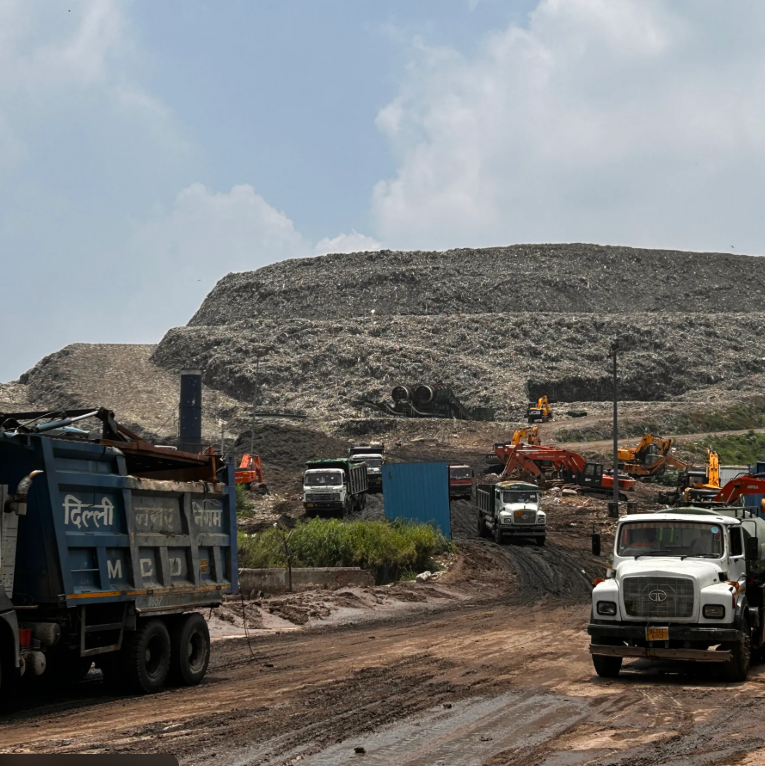
Every morning, a gray haze settles over the northern outskirts of Delhi. Among the fog and fumes, mountains of garbage tower above the skyline — some higher than a 17-story building. These are Delhi’s infamous landfills: Bhalswa, Ghazipur, and Okhla.
For the thousands who live and work near these sites, they are more than just a backdrop — they are a daily threat.
Delhi’s “toxic trash mountains” have become symbols of India’s waste-management failure, a crisis of both policy and survival. While authorities announce deadlines to flatten these garbage hills, they continue to grow, poisoning the air, water, and lives of nearby residents.
The Scale of the Waste Crisis
India generates over 62 million tonnes of solid waste every year, and Delhi alone produces more than 11,000 tonnes daily. Roughly half of it remains unprocessed, dumped at sites that have long exceeded their capacity.
- Ghazipur landfill, started in 1984, was declared “full” in 2002 — yet continues to receive thousands of tonnes daily.
- Bhalswa landfill, opened in 1994, is now over 65 meters high, almost the height of the Qutub Minar.
- Okhla landfill in south Delhi, too, has reached capacity but still receives new waste.
The mountains are not just a visual blight. They emit methane, a highly flammable greenhouse gas, and release toxic leachate — a black, chemical-laden liquid that seeps into the soil and groundwater.
A Public-Health Time Bomb
Residents living near Bhalswa and Ghazipur describe constant coughing, nausea, and skin diseases. Children suffer from chronic respiratory illnesses, and local clinics report higher cases of asthma and bronchitis.
A 2024 study by the Centre for Science and Environment found that air pollution levels around these landfills are up to 15 times higher than safe limits. The garbage burns slowly, releasing a cocktail of harmful gases: carbon monoxide, sulfur dioxide, and dioxins.
The toxic smoke doesn’t just affect those nearby — it drifts into central Delhi, contributing to the city’s notorious winter smog.
“It burns your eyes. The air tastes like plastic,” says Meena, a 32-year-old mother who lives near the Bhalswa landfill. “We cannot move, but we cannot breathe either.”
The Human Cost: Waste Pickers and Forgotten Communities
Thousands of informal waste pickers — many of them women and children — depend on these dumps for their livelihood. They sort through heaps of garbage daily, salvaging recyclables like plastic, glass, and metal to sell for a few rupees.
Without gloves, masks, or any form of protection, they expose themselves to cuts, infections, and toxic fumes. Despite their contribution to recycling — saving the city crores in waste-management costs — they remain unrecognized by the system.
Many live in makeshift homes at the landfill’s edge, often without clean water or electricity. When fires break out — a frequent occurrence — they are the first victims and the last to receive help.
Environmental Fallout: More Than Just Trash
The environmental cost of these landfills goes far beyond local pollution. The decomposition of organic waste releases methane, a greenhouse gas 84 times more potent than carbon dioxide in trapping heat.
Leachate from these dumps contaminates nearby groundwater sources, spreading heavy metals like lead and mercury.
During the monsoon, rainwater mixes with the waste, creating toxic runoff that flows into the Yamuna River, already one of India’s most polluted waterways.
The combination of air, soil, and water pollution has turned Delhi’s waste crisis into an environmental emergency — one that threatens to undo progress in public health, urban planning, and climate resilience.